"If at first you don't succeed, do it the way your mother told you to." -- Author Unknown
Showing posts with label vegan. Show all posts

Tuesday, November 22, 2011

Poora - chickpea flour pancakes

What do you make when you have a guest who is both vegan and follows a gluten-free diet? And you don't have a lot of time? The answer is simple - you make poora! These chickpea flour pancakes are a North Indian staple, easy to make, high in protein and fiber, and delicious. Chickpea flour is available in specialty and fancy food stores, but is far cheaper in Indian grocery stores, where it is labeled "Besan".
1 cup besan (chickpea flour)
½ tsp turmeric
1 tsp ground cumin
½ tsp salt – adjust to taste
About ½ tsp cayenne pepper powder – adjust to taste
About 1 1/2 - 2 cups water (you may not need all of it)
Toppings – chopped scallions, cilantro, tomatoes, red peppers, sour cream/ goat cheese/ Greek yogurt, chutneys, etc.
Canola oil or butter for making the pancakes
  • Sift together the besan, turmeric, cumin, salt, and cayenne. Slowly add water and mix to a smooth paste to get all the lumps out. Then, add more water and mix until it forms a thin pancake-batter like consistency.· Let the mixture sit for about 30 minutes
  • Heat a saucepan and melt a little butter in it or swirl a teaspoon or so of canola oil. – the pancakes can be a bit dry since the batter doesn’t have any eggs or fat in it, so don’t skimp on this part!
  • Make the poora exactly the same way you would make a pancake or crepe – flipping once to cook on both sides. From experience, they turn out better if you use a non-stick pan or a cast-iron griddle (tava). It will take some practice to figure out the correct heat setting and timing for your stove/ pan. I typically cook them on medium-high heat, about 2-3 mins per side.
  • Serve topped with finely chopped herbs/ scallions, your favorite chutney, or with a side of yogurt or cucumber raita. Or you can also use it as a crepe and fill it with creamed spinach, sautéed vegetables, etc. One of my favorite ways to serve this is as a crepe, with sauteed spinach and feta cheese
  • Variations: add any or all of these into the batter before cooking: ½ of an onion, a 1” piece ginger, peeled and grated, one chile pepper, finely minced, grated carrots.

Monday, November 14, 2011

Baba Ghanouj with red peppers


I love baba ghanouj, that creamy and smoky eggplant (aubergine for you Euro-types) dip served in most Mediterranean restaurants. But it had always seemed a little too ambitious for me to try and make it myself - until recently, when we were grilling some other veggies and I had two fat glossy eggplants in the fridge and some sweet red peppers from a local farmer.... as always, I took creative license with the recipe I had. And it turned out wonderfully! I don't think I'll ever buy pre-made baba ghanouj again!
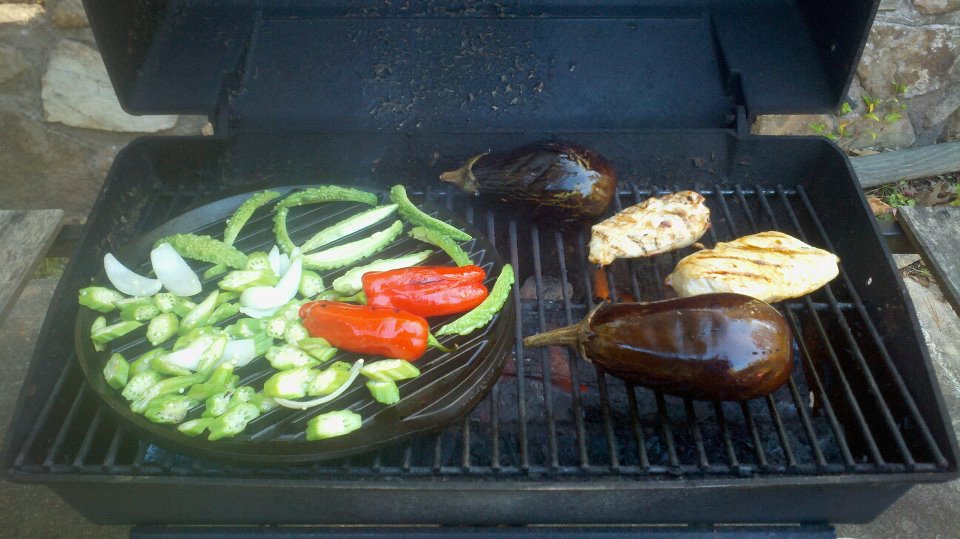
I poked the eggplants with a fork a few times to vent, then rubbed the eggplants with good-quality olive oil. I roasted them on the grill, turning occassionally, until the skins were charred and the eggplant was soft - this took about 25 - 30 minutes. I rubbed the red peppers with olive oil and roasted them about 15 minutes. I also roasted a whole head of garlic with the skins on. When the veggies were cool enough to handle, I rubbed and peeled the skin off using my fingers.
Then:
  • Chop the eggplant flesh coarsely and put in a big bowl. Mash the flesh with a fork until desired consistency. (You can also puree in food processor but I was too lazy to get mine out! Plus I liked the chunky texture of hand-mashed baba ghanouj)
  • Add 1/3 cup tahini, juice from one lemon, about 1/2 teasp salt, and lots of fresh ground black pepper.
  • Chop the red pepper finely; add it and 2 cloves of roasted garlic to the mixture and stir.
  • Drizzle some olive oil on top before serving.
Here's my yummy Mediterranean platter that I had for dinner with some grilled pita bread. Clockwise from top: Baba ghanouj with roasted red pepper, kalamata olives, sauteed spinach, feta cheese, and chopped tomatoes.

Tuesday, October 25, 2011

Not for the faint of palate - bitter melon


I've posted about my experiment in growing bitter melon in our backyard veggie garden, and about how much I love the bitter tart flavor - definitely not for everyone! You either love or hate bitter melon, and boy do I love it. Here is a popular South Indian way to prepare this vegetable. You can find it at Indian or Oriental grocery stores, and if you are lucky and live in the Southern US, sometimes you can find locally grown bitter melon at your farmer's market.
This is a traditional recipe from my dad's side of the family - my Auntie Santha makes a fabulous version. I've modified it to simplify somewhat while keeping the flavor.
Paavakkai Pittla
2-3 good sized bitter melons
1 tbsp tamarind paste concentrate (I use Tamicon brand, available at Indian grocery)
1 tsp Indian mustard seeds
1/4 tsp asafoetida powder
1/2 tsp turmeric
1 tbsp dark brown sugar
1 tsp cayenne powder or more to taste
salt and pepper to taste
canola or vegetable oil for popping mustard seeds
  • In a small bowl, dissolve the tamarind paste in 1/2 cup hot water, stirring until the lumps disappear. Set aside.
  • Slice the bitter melons lengthwise, scoop out the seeds and the white pith, then slice crosswise into thin slices.
  • In a nonstick saucepan, heat about 2 tbsp canola or vegetable oil. Add mustard seeds - they will pop. When they start popping, add the asafoetida powder, turmeric powder, stir, and add the bitter melon.
  • Saute for about 2 mins, then add the tamarind water and cayenne.
  • Simmer uncovered, stirring occasionally, until bitter melon is tender and most of the liquid is absorbed. This will take about 10 - 20 mins depending on how thin you sliced them.
  • Add the brown sugar and salt to taste.
  • Serve as a side dish, with plain yogurt to cut the bitterness.

Enjoy! Do let me know if you try this, and what you think of it.

Monday, October 17, 2011

Lunchbox adventures: pasta and chickpeas


Packing a healthy lunch for my almost-vegetarian, no-sauce eating child can get repetitive after a while. There are only so many peanut butter-honey sandwiches and cheese sandwiches one can make. So I'm always looking for easy variations that are kid-friendly, can be eaten cold, and pack enough nutrition and protein to keep my big girl full and energetic through the school day.

One of our favorite lunches is Pasta and Chickpeas. It lends itself well to endless variations by changing up the vegetables and herbs you mix it with. Using canned chickpeas or leftover cooked chickpeas and leftover vegetables makes this a snap. I used some chickpeas that I set aside when I made another dish.

To make Pasta and Chickpeas, toss together:
1/2 to 3/4 cup cooked pasta - use interesting shapes like bowties, small shells, wheels, or fusilli for different textures and visual appeal.
1/2 cup cooked chickpeas (canned chickpeas, drained and rinsed, will work just fine!)
1 tbsp pesto - or use plain olive oil and other chopped herbs if your child won't eat pesto
about 1/2 cup veggies of your choice that your child will eat - cooked peas, halved cherry tomatoes, red pepper strips, steamed broccoli florets, finely chopped fresh spinach, etc.
couple tablespoons shredded Parmesan cheese (optional; leave this out for a vegan dish).
Salt and pepper to taste.

Monday, October 10, 2011

Chickpeas fit for a Goddess


The Hindu goddess festival of Navaratri (nine nights) just ended. This festival celebrates the different forms of the Goddess and all Her bounties and blessings. When I was growing up, we would make an elaborate stair-step display of all the deity statues in our home, adorned with flowers, streamers, and other beautiful decorations. We'd visit all our friends' houses to admire their displays, and sing songs in praise of the Goddess. We would exchange small tokens of adornment and beauty such as bindis and bracelets. Of course, no festival is complete without food!
One of the traditional snacks that people serve visitors during Navaratri is Chundal (also pronounced "Sundal" or with a consonant sound somewhere between an "S" and a "CH", depending on your dialect and accent). Chundal can be made with almost any kind of dried bean or legume, but is most commonly made with chickpeas. During the recent Navaratri festival, I made Chundal to share at a small prayer celebration. I had bought some indian black chickpeas (Kala Chana), and had some regular light brown chickpeas. So I combined the two to make Chundal. It was a hit with the whole family! I hope you'll try it. Also try it with black-eyed peas, mung beans, or Adzuki beans. It couldn't be simpler to make and the flavors come together beautifully. High in protein and fiber, low in fat.

3 cups chickpeas, sorted through for pebbles and rinsed
1/2 cup frozen grated coconut (Found in Indian grocery stores ; if you can't find this, try unsweetened dessicated coconut)
1 large sprig curry leaves (if you can't find this, substitute Thai basil or regular basil)
2 tsp Indian black mustard seeds
3-4 dried red chiles, use more or less to taste
Pinch of asafoetida powder (optional)

Soak the chickpeas at least 4 hours or overnight, then cover with a generous amount of water and boil or pressure cook till tender but not mushy. Drain and return to the pot. Of course, you can always go the shortcut route and use canned chickpeas. Nothing wrong with shortcuts! Make sure you drain and rinse the chickpeas if using canned.
In a separate pot, heat 2 tablespoons of canola or peanut oil, add the mustard seeds till they splutter and begin to pop. Add the red chiles and curry leaves and heat through to flavor the oil. Add asafoetida if using. Dump the entire mixture into the pot with the chickpeas, add the coconut and salt to taste. Mix well. Serve at room temperature.

Thursday, September 15, 2011

The Man Also Cooks (Sweet potato leaves)


One of the secrets to a successful marriage, in my humble opinion, is having two partners who can cook, clean, bathe the children, etc. Sometimes The Hubby cooks dinner, and I am always super appreciative. He made dinner on a weeknight last week. I had bought some sweet potato leaves and Silver Queen corn from the Durham Farmer's Market . I was introduced to sweet potato leaves by a co-worker from China. She tells me that sweet potato leaves are even higher in iron and Vitamin C than spinach, though it is typically a food that is eaten by poor people. Well, I think it's rich and delicious enough to be a treat for everyone! And I'm always happy when I find it at the market. This is another one of those treasures that you can't find at the big grocery stores.

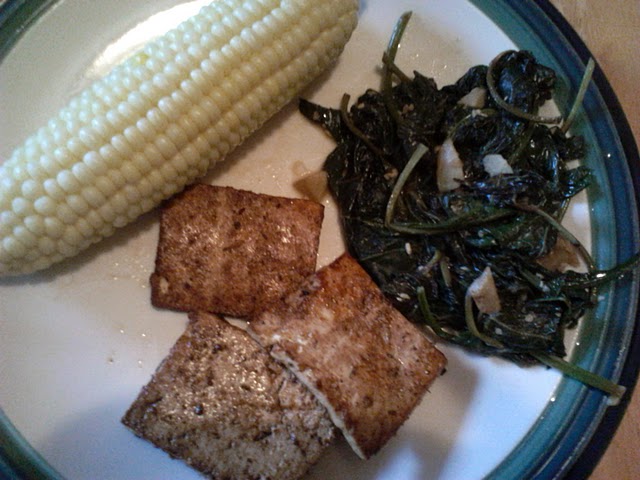
The dinner: Blackened Tofu, sweet potato leaves braised with garlic, and fresh buttered corn. Served with wheat rolls. Mouth-watering!
To make the blackened tofu: slice a slab of extra-firm tofu into 1-inch thick slabs. Drain on paper towels, press another paper towel on top gently to drain out as much water as you can. Rub the tofu with Cajun blackened seasoning, then pan-fry in hot peanut or canola oil till slightly crispy on the outside.

To make the sweet potato greens: Wash the greens and cut each leaf off at the stem. We left them whole, though they could be chopped. Heat some olive oil in a saucepan, and sautee some coarsely chopped garlic until fragrant. Add in the washed sweet potato greens and sautee for a minute or two. then, add half a cup to one cup of good quality, low-sodium vegetable broth and allow to simmer for 10 minutes until tender. Serve hot. They tasted a bit like spinach, a bit like collards, and a bit like sweet potatoes - altogether very tasty.

Fabulous, delicious, nutritious, EASY weekday dinner. Thank you Man of the House!

Tuesday, August 30, 2011

Vegan Carrot Coconut Bisque


At last, a non-tomato post! I had a lot of leftover baby carrots and celery sticks from a dinner party and got tired of eating them raw, so I came up with this creation.
It is a simple soup to make, yet is elegant enough to serve when company comes over. This soup is very rich-tasting and the coconut and ginger give it a far-eastern flavor. I think I could have used less coconut milk and added more pepper. you can probably substitute onions for the celery and get a slightly stronger taste. I have also made this soup using pumpkin and butternut squash instead of carrots, and have used thyme and onions instead of celery. Makes about 8 cups of soup.

about 1 cup of celery, chopped
about 3 cups of carrots, chopped
a one-inch piece of fresh ginger, peeled and chopped
1 carton (4 cups) vegetable broth
1/2 can (about 1/2 to 3/4 cup) coconut milk
enough olive oil to sautee
2 bay leaves
salt and pepper to taste

In a large soup pot, heat the olive oil then sautee the celery, ginger, and bay leaves for about 5 - 7 minutes. Add the carrots then sautee for 2 more minutes. Add in the vegetable broth, lower heat to medium, cover pot.
Simmer an additional 15 - 20 minutes until the carrots are soft.
Add coconut milk and simmer another 5 mins.
Remove the bay leaves, then puree in a blender or using an immersion blender, until smooth.
add salt and pepper to taste, then serve. You may not need to add any salt if the veg broth is already salty.

Enjoy!!

Tuesday, August 23, 2011

Aloo-baingan-bhindi masala

I mentioned a couple of weeks ago that I am blessed with such an abundance of okra from the garden! My grandmother always told us okra will make you good at math - sadly, that reasoning has not worked with my two children, who refuse to eat it. Even though the way I prepare it, it's not slimy. Hubby will politely eat it but only if he has to. No matter, more for me to eat! Some day they may realize the wondrous vegetable that is okra. Here's a delicious dry curry that I made with some local eggplant and tender potatoes, some of my forty two tomatoes, and fresh okra from our garden. I ate it with rice, plain yogurt, and a simple salad of cucumbers, chickpeas, banana peppers with a squeeze of lime.

2 small potatoes, peeled and diced
2 cloves garlic, finely chopped
1 slender Asian eggplant, sliced lengthwise then into 1" thick strips cross-wise
about a dozen okra, washed, gently patted dry, then sliced cross-wise
1 large tomato, seeded and chopped
1 teasp each ground cumin and coriander
1/2 teasp turmeric powder
1/2 teasp cayenne powder or more if you can handle more heat
vegetable oil for sauteeing - about 2 tablespoons
salt to taste
1 sprig curry leaves (you can substitute fresh thai basil or cilantro if you can't find curry leaves - it won't have the same flavour but will still be delicious)


  • Heat the vegetable oil in a large nonstick saucepan, and fry the garlic and curry leaves till fragrant. (if using basil or cilantro, don't add it now, add it at the end)

  • Add the potatoes and eggplant along with the cumin, coriander, tumeric, and cayenne, lowe heat to medium and stir-fry for about 5 minutes until they begin to soften.

  • Add the tomatoes and about 1/4 cup water, and let the potatoes and eggplant cook until softened. Stir occassionally. It's okay if it sticks a bit to the bottom of the pan. This may take 10 - 15 minutes.

  • When the tomatoes and water have been absorbed into the eggplant and potatoes, add the sliced okra.

  • Gently stir-fry until the okra is just tender. It doesn't need to be over-cooked; that's when it gets slimy.

  • add salt to taste and serve!

Tuesday, August 16, 2011

Soap-acho! (Gazpacho)


The logical thing to do when it's high summer and you have foolishly bought forty-two tomatoes, is to make Gazpacho. Much as I love this classic cold tomato soup, I have never tried to make it, because I'm always afraid it won't taste as good as the ones I get in the restaurants. Armed with my cooked tomatoes from the Great Tomato Experience, and fresh cucumbers, bell peppers, and basil from my garden, I decided to chance it.

I turned to my trusty Betty Crocker Newlyweds Edition cookbook and modified good old Betty's recipe. It was amazing and delicious. I must have eaten three bowls full.

The children loved putting everything in the food processor and they actually both enjoyed eating it. Even the child who won't eat anything runny or saucy. The three year old calls it Soap-acho! So that's what we've all started calling it too.

Here's how I made it (and I know there are hundreds of recipes out there for soap-acho):
Cut up some whole wheat bread (about 3-4 slices) or fancy bread if you have it, into cubes. Sautee in olive oil to make croutons.
In food processor, use the low setting to process till desired consistency:
4 cups tomatoes, peeled and cooked (or 2 cans of whole tomatoes)
1 small cucumber, (I peeled off the skin but you don't have to)
1 small green capsicum pepper, seeds and stem removed
about 1/4 cup very good quality olive oil
1 teaspoon ground cumin
1 teaspoon fresh ground pepper (or more!)
2 tablespoons cooking sherry or white wine
2 tablespoons white wine vinegar
half of the croutons
handful fresh basil

That's it! I was so greedy for it I didn't even bother chilling it further - the tomatoes were already cold. I drizzled some more olive oil in each bowl, topped with a handful of croutons, and guzzled it down. Yummmm SOAP-ACHO!

Friday, August 5, 2011

Musings on Mujaddara


One thing that many cultures seem to share is a dish that combines lentils and rice or beans and grains - there's the Indian kicchuri, or yellow split peas and rice, the Caribbean peas and rice, the Central American staple of black beans and rice, Italian pasta fazool, and the middle eastern Mujadarra. I didn't learn until a few years ago, that beans and rice together, provide a complete protein. Plus, they are just delicious together.

Mujaddara is one of my favorite dishes to make, especially to feed a crowd. It seems to go well with many different cuisines. Everyone in my family loves it. I understand that it is a middle eastern staple. I have seen recipes with/ without cinnamon, some with cumin, some call for cooking lentils separately, etc. But this is how I make mine. Simple, fabulous goodness.

1 cup basmati or jasmine rice
1 cup brown lentils (the regular European/ french lentil)
3 to 3-1/2 cup water
salt and pepper to taste
1 stick cinnamon, broken into a couple of pieces (or 1 tsp ground)
1 large onion
4 - 6 tablespoons extra virgin olive oil (this is what makes it yummy!)

Rinse the lentils and rice (wash it and drain off the water as best you can), then put it in a large pan with the salt, pepper and cinammon, add the 3 1/2 cups water and soak for 30 mins. Then bring it to a boil, when it boils, stir once and reduce the heat to low. Cover and let it cook slowly till all the water is absorbed (about 20-30 mins). While lentils are soaking, peel the onion, cut in half, slice thinly. In a saucepan, pour a generous amount of extra v. olive oil. Sautee the onions till nice and browned. this can take a while. Set aside. When lentils are cooked, serve topped with the onions.

In the photo, mujaddara served with rainbow Swiss chard and butternut squash yeriseri (South Indian coconut stew - recipe coming in another post). The rainbow chard was just cut in ribbons and sauteed with freshly chopped garlic in the same saucepan using leftover oil from the mujaddara onions.